
Mills-Martin Family Records - Person Sheet
Mills-Martin Family Records - Person Sheet

Individual Notes
• By his second wife, who figures as the defendants in the present action, he had three children.6030, p 2
Census Data
• 1880 Census: San Francisco, San Francisco, California. Age 25, b ME. Parents b ME.6033
Spouses
Individual Notes
• The Slaven brothers had a contract in 1885 for the dredging of the Panama Canal. A stock company was formed, and out of 20,000 shares the firm retained 11,000. The dividends paid on the stock from 1885 to 1888 amounted to $3,000,000. Moses Slaven was in Panama most of the time watching the business, and his daughter claimed that her father, fearing that he might contract fever and die, entered into an agreement with his brother than in the event of his death he would divide his interest in the business between his wife and daughter Eva. The alleged agreement was not reduced to writing. Moses Slaven died in 1886. He made a will appointing his brother his executor and leaving all his property to the widow.5415
• He left a fortune of several millions to his second wife, the stepmother of Mrs. Depierris. The daughter was then a young girl in a convent in Canada, and her uncle, Henry B. Sleven, was appointed her guardian.6032
• He left a fortune of several millions to his second wife, the stepmother of Mrs. Depierris. The daughter was then a young girl in a convent in Canada, and her uncle, Henry B. Sleven, was appointed her guardian.6032
Census Data
• 1870 Census: San Francisco, San Francisco, California. Age 24, b Canada. Carpenter. Living with wife and child in household of Charles C. Terrill.5418
• 1880 Census: San Francisco, San Francisco, California. Age 34, b Canada. Carpenter.6033
• 1880 Census: San Francisco, San Francisco, California. Age 34, b Canada. Carpenter.6033
Marriageabt 18776033
Marr Memobased on age of eldest child
ChildrenRalph (~1878-)
Clair (~1880-)
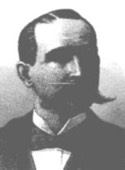
2Henry Bartholomew SLAVEN5415
RemovalFall 1876, San Francisco, San Francisco, California6035, p 1 Age: 22
Removal1880, Panama6035, p 2 Age: 26
Death2 Dec 1904, New York, New York, New York6036 Age: 51
Memoat his home, 119 W 72nd Street
Educationgraduate of the Ontario College of Pharmacy (abt 1870)6035, p 1
FatherPatrick SLAVEN
MotherEliza WELCH
Individual Notes
• Henry B. Slevan married his brother’s widow.6032, p 1
• [He] made a name for himself in the United States. In San Francisco he ran a drug store in the Baldwin Hotel, at the corner of Market and Powell. He expanded into patent medicine and beauty aids, advertising them with trade cards. Later Slaven and his brother Moses were contractors in the building of the Panama Canal.6034
• In 1878, Mr. Slaven became interested in public works, with his brother, M. A. Slaven, who was a successful contractor in California and the far West. It was about this period that Ferdinand De Lesseps paid a visit to San Francisco in the interests of the Panama Canal. The fame of the Slaven brothers, as successful contractors, having reached his notice, he determined to seek their aid in carrying out the vast and difficult work he had in mind. The acceptance of this proposition practically shaped Mr. Slaven’s future life. The brothers assumed entire control of the American Pacific coast business, besides contracting for the buildings and other preliminary work on the Isthmus, which involved millions of dollars.6035, p 2
• Henry B. Slaven, besides being the present husband of Mrs. Depierris’s stepmother, is also the uncle of the plaintiff. He is well known as one of the chief promoters of the American Construction and Dredging Company, which did most of the work on the Panama Canal. All the parties to the suit are well known in New York society, and the Slavens live at present in a fine city house at 156 West Seventy-eighth Street.6030, p 1
• [He] made a name for himself in the United States. In San Francisco he ran a drug store in the Baldwin Hotel, at the corner of Market and Powell. He expanded into patent medicine and beauty aids, advertising them with trade cards. Later Slaven and his brother Moses were contractors in the building of the Panama Canal.6034
• In 1878, Mr. Slaven became interested in public works, with his brother, M. A. Slaven, who was a successful contractor in California and the far West. It was about this period that Ferdinand De Lesseps paid a visit to San Francisco in the interests of the Panama Canal. The fame of the Slaven brothers, as successful contractors, having reached his notice, he determined to seek their aid in carrying out the vast and difficult work he had in mind. The acceptance of this proposition practically shaped Mr. Slaven’s future life. The brothers assumed entire control of the American Pacific coast business, besides contracting for the buildings and other preliminary work on the Isthmus, which involved millions of dollars.6035, p 2
• Henry B. Slaven, besides being the present husband of Mrs. Depierris’s stepmother, is also the uncle of the plaintiff. He is well known as one of the chief promoters of the American Construction and Dredging Company, which did most of the work on the Panama Canal. All the parties to the suit are well known in New York society, and the Slavens live at present in a fine city house at 156 West Seventy-eighth Street.6030, p 1
Marriage28 May 18896032, p 1; marriage only,6030, p 2