
Mills-Martin Family Records - Person Sheet
Mills-Martin Family Records - Person Sheet
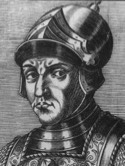
Name“The Conqueror” William I NORMANDY King of England 
Birth1028, Falaise, France5350
Birth14 Oct 1024, Falaise, France5363, p 1
Birth1027, Falaise, France3534, p 109; Line 121, #24
Birth1027/10285348, p 2
Accession25 Dec 1066, Westminster Abbey, London5351, year only,5350 Age: 38
Death9 Sep 1087, Hermenbraville, France5351, year only,5363, p 1,5350 Age: 59
Memonear Rouen
Memotomb despoiled, site marked by a slab
FlagsKing/Queen
FatherRobert II NORMANDY 6th Duke of Normandy (~1008-1035)
MotherHerléve FALAISE (~1012-)
Individual Notes
• He married Mathilda, daughter of Count Baldwin of Flanders, who bore him at least nine children, four of which were sons.5363, p 3
• [excerpts] Duke of Normandy and one of the greatest English kings, William I, b. c. 1028, d. Sept. 9, 1087, led the Norman conquest of England and provided stability and firm government in an age of great disorder. The illegitimate son of the Norman duke Robert I, he inherited Normandy in 1035, consolidating his rule in the face of baronial opposition in about 1042. He successfully faced further rebellions and after 1050 began to take an interest in acquiring land in England -- perhaps given some encouragement by the English kind Edward the Confessor. After Edward’s death (Jan. 5, 1066), Vikings under King Harold III of Norway moved on England, and William soon followed with an invasion force of his own. The new English king, Harold II, defeated the Vikings and confronted the Normans near Hastings in October 1066.
William’s forces achieved a decisive victory, and on Christmas Day 1066, William was crowned King of England, founding the Anglo-Norman monarchy and realm.
While visiting (1051) England, he was probably named by his cousin [not true] Edward the Confessor as successor to the throne, and in 1064 he extracted a promise of support from Harold, then Earl of Wessex. In 1066, hearing that Harold had been crowned King of England, William raised an army and crossed the Channel. He defeated and slew Harold at Hastings and was crowned king.5363, pp 1 & 2
• Edward the Confessor, in an effort to gain Norman support while fighting with his father-in-law, Earl Godwin, had promised the throne to William in 1051. By 1066, however, Edward had reconciled with godwin, and on his deathbed named the Earl’s son Harold as successor to the crown. William felt cheated and immediately prepared to invade, insisting that Harold had sworn allegiance to his accession in 1064. He was prepared for battle in August of 1066, but the winds were against him throughout August and most of September, prohibiting he and his troops from the crossing the English Channel. This turned out to be an advantage, however, as Harold Hardrada, the King of Norway, invaded England and met Harold Godwinson’s forces at Stamford Bridge on September 25, 1066. Godwinson emerged victorious, but two days after the battle, William was able to land unopposed at Pevensey and spent the next two weeks pillaging the area and strengthening his position on the beachhead. The victorious Harold, in an attempt to solidify his kingship, took the fight to William and the Normans on October 14, 1066 at Hastings. Harold and his brothers died fighting in the Hastings battle, removing any further organized resistance to the Normans. The earls and bishops of the Witan hesitated in supporting William, but soon submitted and crowned him William I on Christmas Day, 1066.5363, p 3
• William was a feudal vassal of the King of France (a situation destined to cause great consternation between England and France), and constantly found himself at odds with King Philip. In a siege on the town of Mantes in 1087 he was injured, and he died from complications of the wound on September 9.5363, p 4
• 1066-1087. William I (the Conqueror), of medium height, corpulent, but majestic in person, choleric, mendacious, greedy, a great soldier, governor, centralizer, legislator, innovator.5352, p 191
• 1086. The great Domesday Survey: royal commissions on circuit collected on oath (sworn inquest) from citizens of the counties and vills full information as to size, resources and present and past ownership of every hide of land. The results, arranged by counties in Domesday Book, gave a unique record as a basis for taxation and administration.
The prosperity of England under Norman rule was great and an era of extensive building (largely churches, cathedrals and monasteries) began under the Conqueror and continued even through the anarchy of Stephen and Matilda.5352, p 193
• [excerpts] Duke of Normandy and one of the greatest English kings, William I, b. c. 1028, d. Sept. 9, 1087, led the Norman conquest of England and provided stability and firm government in an age of great disorder. The illegitimate son of the Norman duke Robert I, he inherited Normandy in 1035, consolidating his rule in the face of baronial opposition in about 1042. He successfully faced further rebellions and after 1050 began to take an interest in acquiring land in England -- perhaps given some encouragement by the English kind Edward the Confessor. After Edward’s death (Jan. 5, 1066), Vikings under King Harold III of Norway moved on England, and William soon followed with an invasion force of his own. The new English king, Harold II, defeated the Vikings and confronted the Normans near Hastings in October 1066.
William’s forces achieved a decisive victory, and on Christmas Day 1066, William was crowned King of England, founding the Anglo-Norman monarchy and realm.
While visiting (1051) England, he was probably named by his cousin [not true] Edward the Confessor as successor to the throne, and in 1064 he extracted a promise of support from Harold, then Earl of Wessex. In 1066, hearing that Harold had been crowned King of England, William raised an army and crossed the Channel. He defeated and slew Harold at Hastings and was crowned king.5363, pp 1 & 2
• Edward the Confessor, in an effort to gain Norman support while fighting with his father-in-law, Earl Godwin, had promised the throne to William in 1051. By 1066, however, Edward had reconciled with godwin, and on his deathbed named the Earl’s son Harold as successor to the crown. William felt cheated and immediately prepared to invade, insisting that Harold had sworn allegiance to his accession in 1064. He was prepared for battle in August of 1066, but the winds were against him throughout August and most of September, prohibiting he and his troops from the crossing the English Channel. This turned out to be an advantage, however, as Harold Hardrada, the King of Norway, invaded England and met Harold Godwinson’s forces at Stamford Bridge on September 25, 1066. Godwinson emerged victorious, but two days after the battle, William was able to land unopposed at Pevensey and spent the next two weeks pillaging the area and strengthening his position on the beachhead. The victorious Harold, in an attempt to solidify his kingship, took the fight to William and the Normans on October 14, 1066 at Hastings. Harold and his brothers died fighting in the Hastings battle, removing any further organized resistance to the Normans. The earls and bishops of the Witan hesitated in supporting William, but soon submitted and crowned him William I on Christmas Day, 1066.5363, p 3
• William was a feudal vassal of the King of France (a situation destined to cause great consternation between England and France), and constantly found himself at odds with King Philip. In a siege on the town of Mantes in 1087 he was injured, and he died from complications of the wound on September 9.5363, p 4
• 1066-1087. William I (the Conqueror), of medium height, corpulent, but majestic in person, choleric, mendacious, greedy, a great soldier, governor, centralizer, legislator, innovator.5352, p 191
• 1086. The great Domesday Survey: royal commissions on circuit collected on oath (sworn inquest) from citizens of the counties and vills full information as to size, resources and present and past ownership of every hide of land. The results, arranged by counties in Domesday Book, gave a unique record as a basis for taxation and administration.
The prosperity of England under Norman rule was great and an era of extensive building (largely churches, cathedrals and monasteries) began under the Conqueror and continued even through the anarchy of Stephen and Matilda.5352, p 193
Spouses
Birthabt 10315364
Birth10323534, p 109; Line 121, #24
Death3 Nov 10833534, p 109; Line 121, #24 Age: 52
FatherBaldwin V FLANDERS Count of Flanders (1012-1067)
MotherAdele DE FRANCE (-1079)
Marriage1053, Normandy, France5351, marriage only,5363, p 1,5350
Marr MemoCathedral of Notre Dame d’Eu
ChildrenRobert II (1054-1134)
Adeliza (1055-)
William II (~1058-1100)
Richard (~1055-)
Cecilia of Holy Trinity (1056-)
Agatha (~1064-)
Constance (~1066-)
Adela (~1067-1137)
Matilda
Henry I (~1068-1135)